
Table of Contents
ToggleHard water leaves soap scum on shower doors, scale buildup in pipes, and a chalky film on dishes. If you’ve installed a water softener, or you’re troubleshooting one that’s underperforming, the salt you choose matters more than most homeowners realize. Dura Cube water softener salt (often spelled duracube water softener salt) is a compressed sodium chloride product designed to regenerate ion-exchange resin efficiently, reduce bridging, and cut down on brine tank maintenance. Unlike rock salt or solar salt crystals, Dura Cube pellets are extruded under high pressure, resulting in a denser, purer product that dissolves predictably and leaves less residue. This guide walks through what sets Dura Cube apart, how to use it correctly, and what to do when problems arise.
Key Takeaways
- Dura Cube water softener salt achieves 99.8% purity through an extrusion process that resists bridging, reduces maintenance frequency to every two to three years, and minimizes brine tank sludge compared to lower-grade rock salt.
- The controlled dissolution rate of Dura Cube pellets maintains consistent brine strength during regeneration cycles, preventing salt waste and improving the efficiency of ion-exchange water softening systems.
- Common hard water issues like bridging (salt crusting) and mushing (sludge buildup) are best prevented by using high-purity evaporated salt pellets such as Dura Cube, keeping the tank properly filled, and maintaining low humidity in utility spaces.
- Proper salt loading technique—checking brine tank water levels, monitoring for bridging, and refilling every four to eight weeks—extends water softener lifespan and ensures reliable soft water delivery.
- If hard water persists despite full Dura Cube salt levels, troubleshoot by confirming the softener’s regeneration schedule, inspecting brine lines for clogs, and testing the resin bed, as issues may stem from mechanical failures rather than salt quality.
- Annual brine tank inspections, monthly hardness testing with test strips, and routine sanitization of the resin bed every 12–18 months are critical maintenance practices that optimize water softener performance and prevent costly repairs.
What Is Dura Cube Water Softener Salt and How Does It Work?
Dura Cube is a brand name for compacted salt pellets manufactured through an extrusion process. Raw sodium chloride is ground fine, then forced through a die under thousands of pounds of pressure to form uniform cylinders, typically about ¾ inch in diameter and ½ to ¾ inch long. The result is a pellet with 99.8% purity and a density that resists caking and mushing in humid brine tanks.
Water softeners work by ion exchange: hard minerals (calcium and magnesium) in your water bind to resin beads inside the softener tank, while sodium ions are released in their place. Over time, the resin becomes saturated. During regeneration, a concentrated brine solution flushes the hard minerals off the resin and sends them down the drain. The brine is created by dissolving salt in the brine tank, this is where your choice of salt comes into play.
Dura Cube pellets dissolve slowly and consistently, maintaining a stable brine concentration. Their low insoluble content (often less than 0.5%) means fewer undissolved particles settle at the bottom of the tank, reducing the frequency of manual cleanouts. The compacted structure also minimizes bridging, a common problem where a hardened salt crust forms above the water line, leaving a hollow void underneath. When bridging occurs, the softener can’t produce brine, and your water stays hard.
Because the pellets are kiln-dried and extruded, they’re less prone to clumping in the bag or tank compared to solar salt crystals, which can contain trace moisture and organic impurities from evaporation ponds.
Key Benefits of Using Dura Cube Salt in Your Water Softener System
High purity translates to less maintenance. With 99.8% sodium chloride and minimal insoluble matter, Dura Cube leaves behind virtually no sludge. Homeowners who switch from rock salt, which can contain up to 5% insoluble material, often notice they’re cleaning the brine tank once every two to three years instead of annually.
Reduced bridging and mushing. The dense, uniform pellets resist humidity better than solar crystals. In damp basements or utility rooms, bridging can form within weeks using lower-grade salts. Dura Cube’s engineered consistency keeps pellets breaking down evenly, which is critical if you travel frequently or run an automatic softener that regenerates on a timer.
Efficient dissolution for consistent brine strength. Regeneration cycles depend on a saturated brine solution, typically around 26% salt by weight. Pellets that dissolve too quickly can create localized super-saturation and waste salt: pellets that dissolve too slowly may not keep up with demand. Dura Cube’s controlled dissolution rate matches the timing of most residential softener regeneration cycles, which usually run two to four hours.
Extended equipment lifespan. Insoluble sediment and organics from lower-grade salts can coat resin beads, reducing ion-exchange capacity and forcing the softener to regenerate more often. Over time, this accelerates resin degradation. Using a high-purity salt like Dura Cube minimizes fouling and can add years to the service life of the resin bed, which typically costs $200–$400 to replace.
Easier handling. The pellets are less dusty than rock salt and don’t clump inside the bag. If you’re hauling 40-pound bags from the garage to a basement brine tank, this small ergonomic advantage adds up over the years.
How to Choose the Right Water Softener Salt for Your Home
Not all salt is created equal, and your softener’s manual will usually list acceptable types. The three most common forms are rock salt, solar salt crystals, and evaporated salt pellets (which includes Dura Cube).
Rock salt is the cheapest option, mined directly from underground deposits. It contains 95–98% sodium chloride and carries dirt, calcium sulfate, and other minerals. It works, but expect to clean the brine tank more often and watch for bridging. Best for budget-conscious users with easy tank access and hard water below 10 grains per gallon.
Solar salt crystals form through evaporation of seawater or brine in large outdoor ponds. Purity typically runs 99.5–99.6%. Crystals dissolve faster than pellets, which can be useful if you have a high-capacity softener that regenerates nightly. But, they’re more prone to clumping in humid conditions and can leave a thin layer of sediment over time. Homeowners in coastal or high-humidity climates often report issues.
Evaporated salt pellets (including Dura Cube and similar brands like Diamond Crystal Bright & Soft or Morton Clean & Protect) are produced by dissolving raw salt, filtering impurities, then evaporating and compacting the crystals. Purity reaches 99.8% or higher. These are the premium choice for most residential systems, especially for homeowners who want hands-off operation and minimal maintenance.
Iron-fighting formulas exist for well water with elevated iron. These products add a rust remover (often citric acid or a proprietary resin cleaner) to the salt. If your water has more than 0.3 parts per million iron, or you notice orange staining, consider an iron-out additive or dedicated salt. Standard Dura Cube won’t address iron fouling on its own.
Potassium chloride pellets are an alternative to sodium for people on low-sodium diets or in regions with sodium discharge restrictions. They work the same way but cost roughly three times as much and require 10–15% more product per regeneration. Only switch to potassium if your softener is rated for it and you have a specific health or regulatory reason.
Step-by-Step Guide to Adding Dura Cube Salt to Your Water Softener
Adding salt is straightforward, but doing it correctly extends equipment life and prevents bridging. Follow these steps every time you refill.
1. Check the brine tank water level. Lift the lid and look inside. You should see water covering the bottom, usually 4 to 6 inches deep, depending on your model. If the tank is bone-dry or overflowing, stop. A dry tank may indicate a clogged brine line or failed float valve: an overflow suggests a stuck float or faulty control valve. Address those issues before adding salt.
2. Inspect for bridging or salt mushing. Use a broom handle or long dowel to gently probe the salt pile. If the handle hits a hard crust but then breaks through into a hollow space below, you have bridging. If the probe sinks into a thick sludge at the bottom, you have mushing. Both require a full cleanout (see Troubleshooting).
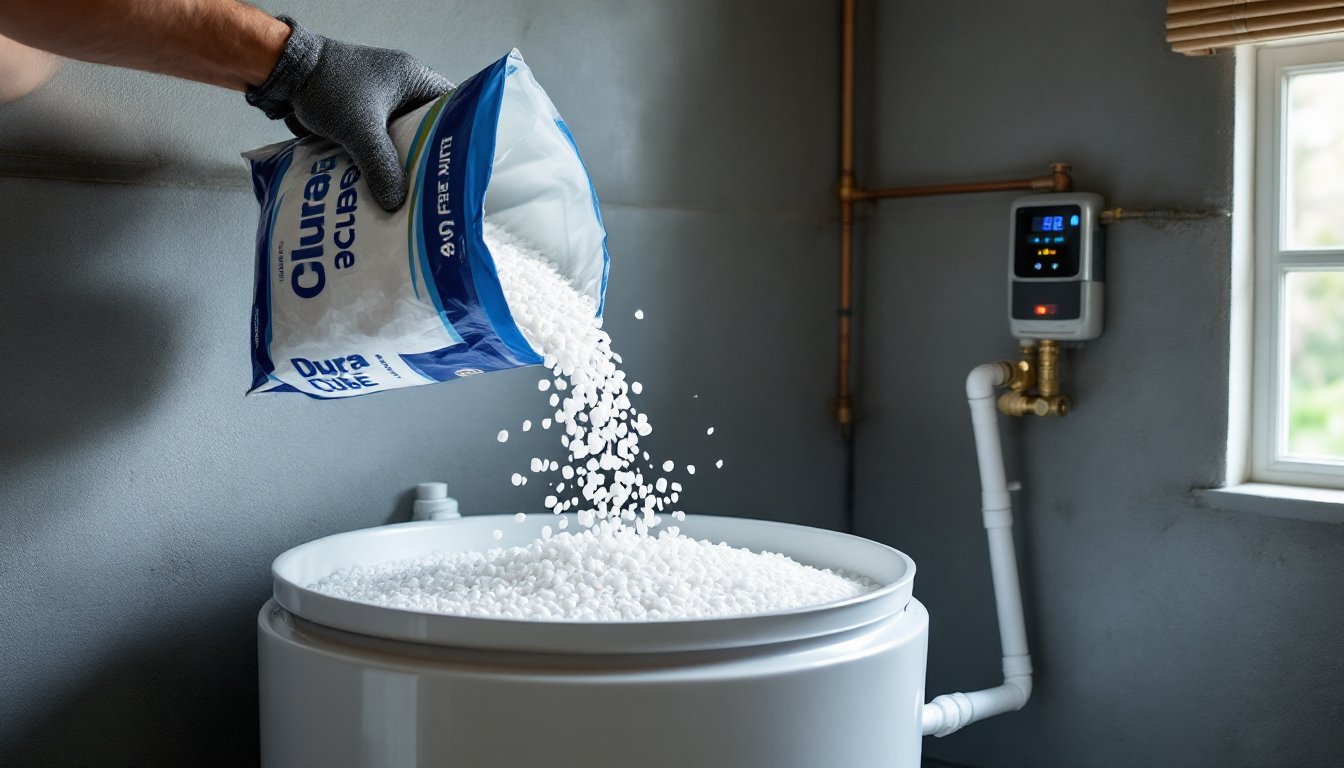
3. Add Dura Cube pellets to the manufacturer’s recommended fill line. Most residential brine tanks have a maximum fill indicator molded into the sidewall or marked on a sticker. As a rule, keep the salt level at least 3 inches above the water line and no higher than two-thirds of the tank’s total height. Overfilling can cause bridging and makes it harder to monitor water levels.
4. Don’t top off too frequently. Let the salt level drop to about one-quarter full before adding more. This gives you a chance to inspect the tank interior and ensures fresh salt mixes with any remaining older pellets. For most households, this means refilling every four to eight weeks, depending on water hardness and household size.
5. Break up large bags before pouring. If the bag has been sitting in a garage through a humid summer, pellets may have clumped. Give the bag a few firm taps on the ground to break up any chunks, then pour slowly to avoid splashing brine or damaging the salt grid at the bottom of the tank.
6. Close the lid securely. This keeps out dust, insects, and humidity. A loose lid accelerates clumping and can allow foreign material into the brine, which fouls the resin.
7. Monitor the first regeneration cycle. If you’ve just installed the softener or switched salt types, check the brine tank the morning after the first regen. The water level should have dropped slightly as brine was drawn into the resin tank, then refilled automatically. If it didn’t, you may have an air gap in the brine line or a miscalibrated control head.
Common Issues and Troubleshooting Tips
Bridging: The most common complaint is a salt bridge, a hardened crust that spans the width of the tank, leaving a hollow cavity underneath. This prevents new pellets from dissolving and stops brine production. To fix it, turn off the softener, then carefully break the bridge using a broom handle or similar tool. Scoop out large chunks, then run a manual regeneration cycle. Prevent bridging by using high-purity pellets like Dura Cube, avoiding overfilling, and keeping humidity in check with a dehumidifier in damp basements.
Mushing: Sometimes called “sludge,” mushing is a thick slurry of partially dissolved salt, water, and sediment at the tank bottom. It forms when low-quality salt breaks down unevenly or when the tank water level is too high. To resolve it, shut off the water supply, bail out the brine, and scoop out the sludge. Rinse the tank thoroughly, check and clean the brine well (the vertical tube inside the tank), then refill with fresh Dura Cube. Prevent mushing by using evaporated pellets and ensuring the float valve is calibrated correctly.
Salt clumping in the bag: If pellets have hardened into a solid block, the bag was likely stored in a humid area or exposed to temperature swings. Store bags on a pallet or shelf in a climate-controlled space. Once opened, reseal the bag tightly or transfer pellets to a sealed plastic bin.
Water stays hard even though full salt: First, confirm the softener is regenerating on schedule. Check the control valve display or listen for the motor and water flow during the programmed regen time. If it’s regenerating but water remains hard, test the brine tank, there should be a visible brine draw (water level drops) during the cycle. If not, inspect the brine line for kinks or clogs. Also check the resin bed: if it’s over 10 years old, it may be fouled or exhausted and need replacement. Guidance on diagnosing common water softener problems can help narrow down mechanical issues.
Iron staining even though using Dura Cube: Standard sodium chloride won’t remove iron from water: it only softens it. If your well water contains iron, you’ll need a dedicated iron filter upstream of the softener or a salt formulated with rust removers. Some tested water treatment solutions include combination softener-iron filters that handle both minerals in one unit.
Salt usage seems high: Track your consumption over a few months. A typical household uses one 40-pound bag every four to six weeks. If you’re going through a bag every two weeks, your softener may be over-regenerating due to incorrect hardness settings in the control valve. Retest your water hardness (test strips are $10–$15) and reprogram the controller. Also check for continuous water flow into the brine tank, which indicates a stuck float valve.
Maintenance Best Practices for Optimal Performance
Annual brine tank inspection: Once a year, let the salt level drop low, then open the tank and inspect the walls, grid platform, and brine well for sediment or salt crust. Wipe down the interior with a damp cloth and check that the float moves freely.
Sanitize the resin bed every 12–18 months: Pour one cup of household bleach (unscented) or a commercial resin cleaner into the brine tank, then run a manual regeneration. This kills bacteria and algae that can form in the moist resin environment. Do this when the salt level is low to ensure the sanitizer reaches the resin.
Check and clean the venturi and nozzle: These small components create the suction that draws brine into the resin tank. Over time, sediment or iron can clog them. Most control valves have a removable venturi assembly, consult your manual for location and cleaning procedure. A toothpick or small wire can clear clogs: rinse thoroughly before reinstalling.
Test hardness monthly: Use test strips or a liquid kit to confirm your softener is delivering soft water (0–1 grains per gallon). If hardness creeps up, troubleshoot before scale builds up in your plumbing.
Keep the area around the softener dry: Humidity accelerates salt clumping and can corrode metal fittings. Run a dehumidifier in basements or utility rooms, especially in summer.
Log salt additions and regeneration frequency: A simple notebook or phone app helps you spot trends, like a sudden increase in salt use or longer intervals between refills, that signal a problem before it becomes an expensive repair.
Conclusion
Dura Cube water softener salt delivers the purity, consistency, and low-maintenance performance that most homeowners want from their water treatment system. By choosing a high-quality evaporated pellet, following proper loading procedures, and staying on top of routine inspections, you’ll keep hard water at bay and extend the life of your softener. When issues do crop up, bridging, mushing, or unexpected hardness, the troubleshooting steps above will get you back to soft water without a service call. For more home maintenance guides and seasonal checklists, explore the full library at Suite Exclusive.