Table of Contents
ToggleHilti isn’t the first name most DIYers think of when shopping for a miter saw, and that’s exactly why it’s worth a closer look. Known primarily for dominating commercial job sites with rotary hammers and powder-actuated fastening tools, Hilti has developed a smaller but highly regarded lineup of miter saws that bring the same rugged reliability to trim work, framing, and finish carpentry. These aren’t the saws you’ll find stacked in big-box home centers. Hilti tools are typically available through direct sales or specialized dealers, aimed at contractors who need equipment that survives heavy daily use. But for serious DIYers tackling crown molding, deck builds, or furniture projects, a Hilti miter saw offers precision and durability that can outlast consumer-grade alternatives.
Key Takeaways
- Hilti miter saws deliver commercial-grade durability and precision for serious DIYers, with die-cast aluminum frames and electronic torque management that maintain blade speed under load.
- A Hilti miter saw excels for trim, crown molding, and furniture projects where repeatable accuracy and compound angle cuts are essential, with dual-bevel models eliminating the need to flip workpieces.
- Priced between $600–$1,200, Hilti miter saws cost more upfront than consumer brands but offer stronger resale value (50–60% retention) and longer tool life, making them worthwhile for multiple room renovations or regular woodworking.
- Key models like the SM 12-125 (12-inch dual-bevel) and SM 10-100 (10-inch single-bevel) feature integrated laser guides, special crown molding detents (31.6°), and compact sliding designs that maximize cutting capacity in small shops.
- Proper maintenance—including monthly rail cleaning, regular calibration checks, and dust collection setup—keeps your Hilti miter saw square and operating at peak performance for decades.
What Makes Hilti Miter Saws Stand Out for Homeowners and DIYers
Hilti miter saws are engineered for commercial-grade durability. The frames are typically die-cast aluminum or reinforced composite, designed to handle repeated transport and long cutting sessions without losing calibration. This matters when you’re installing baseboards in multiple rooms or cutting rafters over a weekend, the saw stays square.
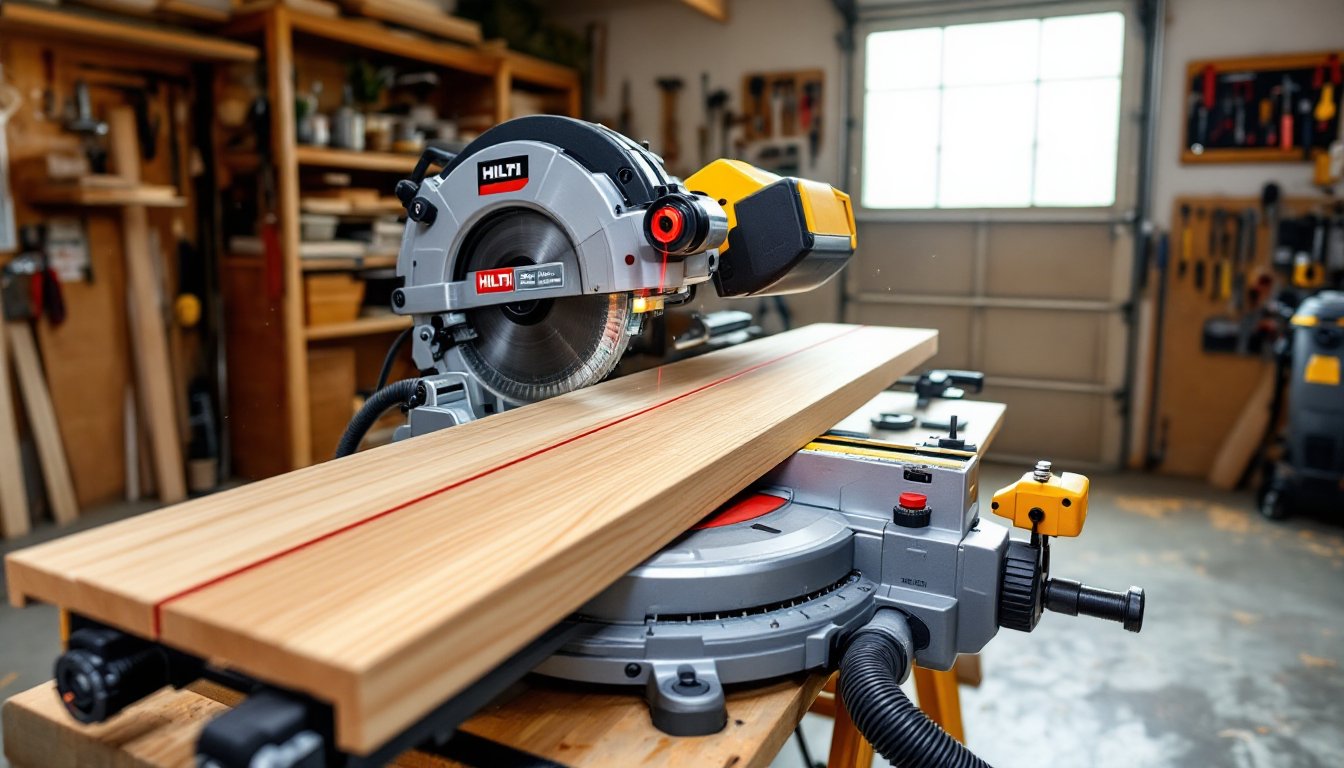
The brand’s sliding compound models feature dual horizontal rails that keep the saw head close to the fence, maximizing cutting capacity without requiring excessive space behind the tool. If you’re working in a garage or basement shop with limited depth, this design allows full crosscut capacity on 12-inch stock without the saw overhanging your bench.
Another distinguishing feature: laser guide systems and LED shadow lines on many models. While lasers can drift out of alignment, Hilti’s integrated systems are mounted directly to the blade arbor, moving with the blade for consistent accuracy. The shadow line projects the blade path onto the workpiece, which some carpenters prefer because it shows kerf width, not just a reference line.
Hilti backs its tools with a no-wear guarantee on certain components and a tool replacement program for commercial users. While DIYers won’t typically enroll in fleet services, the warranty reflects the company’s confidence in longevity. If you’re investing in a saw you plan to use for decades, not just a single project, that matters.
Key Features and Specifications to Know
Most Hilti miter saws run on 15-amp motors delivering between 3,200 and 4,000 RPM, depending on blade diameter. That’s comparable to other pro-grade saws from Bosch, DeWalt, or Makita. The difference shows up in torque management, Hilti motors use electronic feedback to maintain blade speed under load, reducing bogging when cutting dense hardwoods or pressure-treated lumber.
Blade capacity varies by model. A 10-inch Hilti saw typically handles 5-1/2 inches of crown molding nested, or a 2×8 dimensional lumber at 90 degrees. The 12-inch models step up to 6-1/2-inch crown and 2×12 crosscuts. Miter ranges generally extend to 50 degrees left and right, with detents at common angles (0°, 15°, 22.5°, 31.6°, 45°). The 31.6-degree detent is specifically for crown molding cut flat.
Bevel capacity on dual-bevel models tilts 48 degrees left and right, with detents at 0°, 22.5°, 33.9°, and 45°. The 33.9-degree bevel pairs with a 31.6-degree miter for compound crown cuts, eliminating the need to hold molding at an angle against the fence.
Dust collection is handled by vacuum ports sized for standard 1-1/4-inch or 1-7/8-inch shop vac hoses. Hilti saws are designed to pair with their own dust extractors, but any vac with adequate CFM will work. Expect to capture about 75% of dust with a good vacuum, the rest escapes around the blade guard.
Weight ranges from 38 pounds for compact 10-inch models to 58 pounds for dual-bevel 12-inch sliding saws. These aren’t grab-and-go tools. Plan on keeping them on a stand or workbench rather than carrying them up ladders.
Popular Hilti Miter Saw Models Compared
Hilti’s miter saw lineup is leaner than mass-market brands. The SM 10-100 is a 10-inch single-bevel sliding saw suited for framers and trim carpenters who don’t need dual bevel. It’s lighter and faster to adjust, with a vertical cutting capacity of 3-5/8 inches at 90 degrees. This model works well for cutting studs, joists, or exterior trim where bevel cuts are rare.
The SM 12-125 steps up to a 12-inch blade with dual-bevel capability. It’s the go-to for finish carpenters installing crown, baseboards, or custom casings. The larger blade and extended fence accommodate wider stock, and the dual bevel eliminates the need to flip workpieces for opposing compound cuts. For projects featured on platforms like Instructables, where precision woodworking matters, this added flexibility saves time.
Hilti also offers cordless miter saws in their battery platform, though these are less common in the DIY space. Cordless models sacrifice some cutting capacity and motor power but shine in remote locations or for contractors moving between job sites without reliable power access.
Compared to leading miter saws from other brands, Hilti models often include better dust collection integration and more robust fence systems, but they lack some of the conveniences you’ll find on consumer-focused tools, like built-in work lights or smartphone app connectivity.
Best Uses and Applications for Home Projects
A Hilti miter saw excels in trim and molding installation. The precision miter and bevel adjustments make tight-fitting inside and outside corners achievable on the first cut, reducing waste and frustration. Use a 60-tooth to 80-tooth carbide blade for clean cuts on stain-grade hardwood trim.
For deck building, a Hilti saw handles pressure-treated 2×6 and 2×8 decking and joists with ease. The torque-controlled motor won’t stall in wet or treated lumber, and the dust port keeps your work area cleaner when cutting composite decking materials, which produce fine, clingy dust.
Furniture and cabinetry projects benefit from the saw’s repeatable accuracy. When cutting multiples, like table legs, shelf supports, or drawer fronts, the detent system and laser guides ensure consistent dimensions. Many workshop tutorials call for precise miter joints in frames and carcasses, where even a half-degree error compounds across multiple corners.
Framing and rough carpentry work well on Hilti saws, especially when using the sliding feature for wider stock. Cutting rafters, headers, or blocking is faster with a miter saw than a circular saw when you need repetitive angle cuts. Keep a 24-tooth framing blade on hand for this work, it’ll cut faster and won’t clog in dimensional lumber.
Hilti saws are not ideal for cutting metal or masonry. While you can mount an abrasive blade for aluminum or steel, the saw lacks the RPM and guard design optimized for metalworking. Use a dedicated metal chop saw or cold saw for those materials.
Safety Tips and Maintenance Best Practices
Always wear safety glasses and hearing protection when operating a miter saw. Blade speeds above 3,000 RPM produce noise levels that can damage hearing with prolonged exposure. A dust mask or respirator is essential when cutting treated lumber, MDF, or composite materials that release fine particulates.
Keep hands at least six inches from the blade path. Use the saw’s clamp or a separate hold-down clamp to secure workpieces, never rely on hand pressure alone. For narrow stock, use a push block to keep fingers clear of the cutting zone.
Before each use, check blade tightness and inspect for damaged teeth or cracks. A loose or damaged blade can kick back or shatter. Hilti blades use a standard 5/8-inch arbor, so replacements are widely available. Replace blades when cuts become rough or the motor labors more than usual.
Calibrate miter and bevel angles every few months or after transporting the saw. Use a machinist’s square or digital angle gauge to verify 90-degree and 45-degree settings. Most Hilti saws have adjustment screws behind the miter table and bevel housing to fine-tune these stops.
Clean sawdust buildup from the sliding rails and bevel pivots monthly. Use compressed air or a stiff brush, then apply a light coat of dry lubricant like PTFE spray. Avoid oil-based lubricants, which attract more dust.
Blade changes require unplugging the saw and using the arbor lock. Loosen the arbor bolt by turning it in the direction of blade rotation (usually clockwise to loosen, since the bolt has reverse threads). Store extra blades in protective cases to prevent tooth damage.
Is a Hilti Miter Saw Worth the Investment?
Hilti miter saws typically cost $600 to $1,200, depending on blade size and features. That’s higher than entry-level consumer saws but competitive with other professional-grade brands like Festool or high-end DeWalt models.
For a DIYer who tackles one or two projects a year, a Hilti saw may be overkill. A mid-tier saw from Makita, Bosch, or Ridgid will handle occasional trim work and deck builds at half the price. But if you’re renovating multiple rooms, building furniture regularly, or planning long-term projects that demand precision and durability, Hilti’s build quality pays off in fewer recalibrations and longer tool life.
The resale value of Hilti tools is strong. Contractors recognize the brand, and used Hilti saws hold 50-60% of original value after several years of use, better than most consumer brands.
Consider availability and service. Hilti tools aren’t stocked at Home Depot or Lowe’s. Purchases typically go through Hilti direct sales reps or specialized dealers. Warranty service is handled through Hilti service centers, which may require shipping the tool. For some DIYers, that’s less convenient than walking into a big-box store for a replacement under warranty.
If you value longevity over initial cost and want a saw that won’t need replacing in five years, Hilti delivers. If you need a solid saw for occasional use and want easy local support, other brands offer better value.
Conclusion
Hilti miter saws bring professional-grade precision and durability to home workshops. They’re built for heavy use, feature thoughtful design touches like close-to-fence sliding rails, and hold calibration better than consumer-grade alternatives. For serious DIYers investing in a long-term tool, a Hilti saw is a sound choice, just be prepared for the higher upfront cost and less convenient service network.